
Wapping Wall (the street and riverside)
Wapping Wall evolved from a 16th-century originally defensive, river wall that prevented the river from spilling into the marshland here. Draining of the marshland and construction of the river wall began in around 1327. The wall was frequently breached and this continued to be a problem until the late 16th century at which time the riverside developed into narrow streets with wharves and warehouses to support Wapping’s strong maritime trade.
Wapping was of critical importance to the wealth of London: its unique maritime character attracted many trades associated with the sea and in the 18th century acted as a major centre for the provisioning of a mighty British maritime nation. Gradually, from the 17th and 19th centuries the area became heavily industrialised with docks, shipping, merchant warehouses and was home to sailors, shipbuilders and various port trades. A significant trade in counterfeit goods also grew in the area outside the jurisdiction of the City of London.
The 19th century saw a boom in warehouse construction.
Wapping suffered wartime bombing in WWII and then steep decline after the docks closed mid-20th century; from the 1980s onward the London Docklands Development Corporation and later local authorities promoted conservation and conversion of historic wharf buildings into homes and commercial uses, which is how much of Wapping Wall assumed its present residential character.
Wapping Wall has been designated a Conservation Area by The London Borough of Tower Hamlets
Great Jubilee Wharf
Great Jubilee Wharf comprises three former riverside warehouses on Wapping Wall: Jubilee Wharf, Lower Oliver’s Wharf and Lusk’s Wharf.
These three warehouses were transformed into apartments by Galliard Homes Ltd between 1996 and 1997. The building retains its warehouse features — heavy brickwork, large multi-pane windows, loading doors and external iron fixtures — and today contains bespoke flats with modern interiors while keeping the industrial character. The building and its immediate neighbours, Metropolitan Wharf and New Crane Wharf form part of the continuous line of former wharf/warehouse buildings that face the Thames along Wapping Wall which were adapted for residential use during Docklands regeneration
The authors of The Buildings of England, London 5 East(Bridget Cherry, Charles O’Brien and Nikolaus Pevsner, Yale University Press) make special note of the building and it’s environs:
“The best stretch of large C19 riverside warehouses left on the Thames is in WAPPING WALL where the warehouses of New Crane Wharf and its neighbours form a continuous wall between street and river. First GREAT JUBILEE WHARF, a single block of flats by BUJ Architects, 1996-7, unifying the facades of three former warehouses. The w half (Nos. 78-80) was previously Lusk’s Wharf and Lower Oliver’s Wharf, built in 1890 in four stories and six bays with white brick window heads within giant arcades. Contemporary wrought-iron wall cranes, with a large one to the river. Curious gablets for former transverse roofs have now been repeated across the E half, and a glass-and-timber attic story added. The E half, previously Jubilee Wharf (Nos. 76-7) was mid-C19, three storied with a plain stucco entablature, now raised in line with its neighbours. Five bays plus one recessed to the street; loading bays with three forged-iron wall-cranes. Cruciform iron columns retained.”
Jubilee Wharf, Lusk’s Wharf & Lower Oliver’s Wharf
Jubilee Wharf, Lusk’s Wharf and Lower Oliver’s Wharf were historic Thames-side warehouse/wharf buildings on Wapping Wall and are recognised for their heritage value: they were Grade II listed on the National Heritage List for England. The listings record typical 19th-century warehouse form and materials and note their importance as survivals of the working riverfront — evidence of the long commercial life of the Thames and the pattern of wharves and storage buildings that served London’s trade. Like many such wharves these buildings have been adapted and conserved rather than demolished, so they survive as an important part of Wapping’s riverside streetscape.
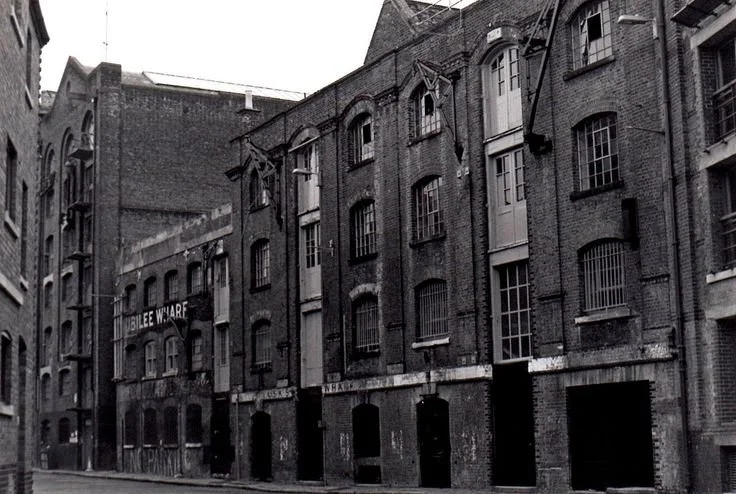
Jubilee, Lusk’s & Lower Oliver’s Wharves around 1960-70
Jubilee Wharf
Jubilee Wharf was constructed around 1850-1860, it is described by Historic England as being contiguous with Metropolitan Wharf to the east, but with its river front set back, being constructed of stock brick with three storeys, river-frontage and hoists etc. It was listed on 1 July 1983 as Grade II on the National Heritage List for England
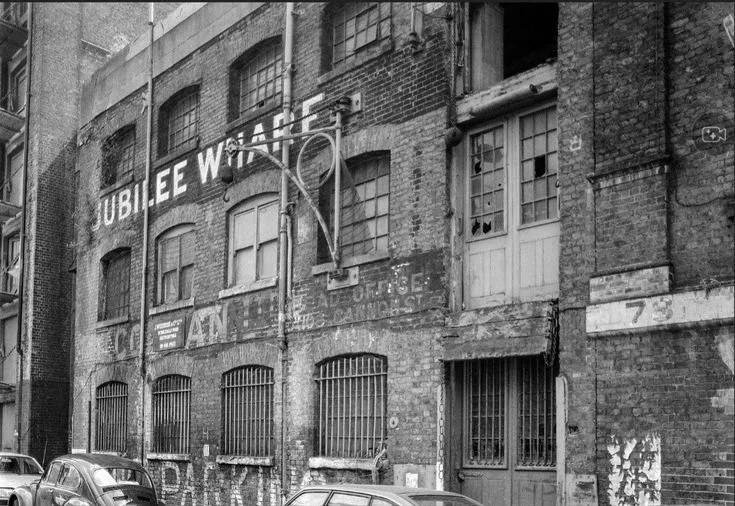
Around 1914 it was owned by COLMAN, J. & J., Ltd., Manufacturers of Mustard, Starch, Corn Flour, Blue, and Self-Rising Flour, 108, Cannon Street, London, E.C.; and Carrow Works, Norwich . . . Warehouses at Jubilee Wharf, Wapping, London, E., and at Great Yarmouth.
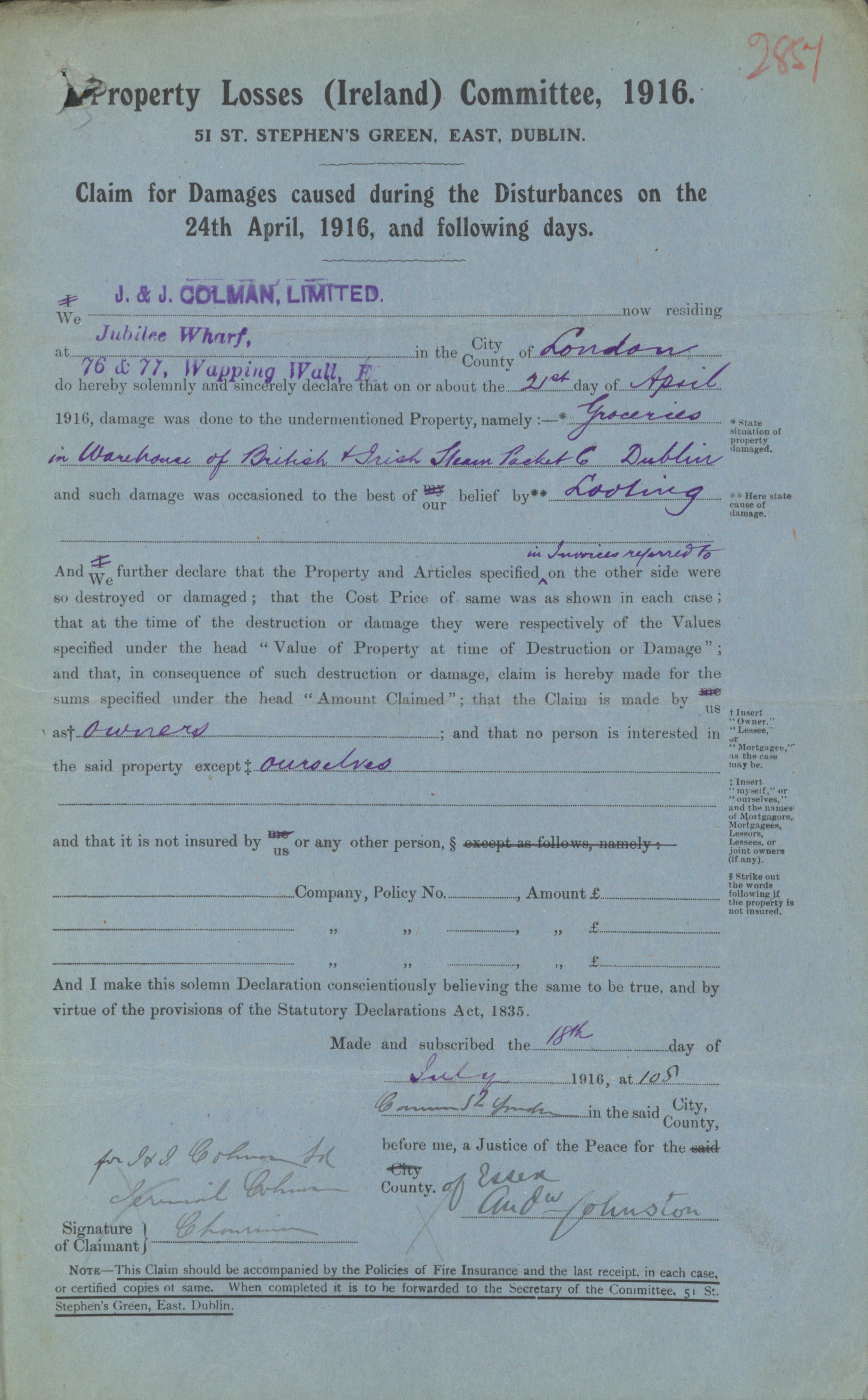
Indeed, the Irish National Archives hold documents recording a claim for damages made by J. J. Colman of Jubilee Wharf, 76 & 77 Wapping Wall for goods lost during the Irish Disturbances on 24 April 1916. The claim is for a consignment of groats and barley shipped by the British and Irish Steam Packet Co. Ltd, which were looted from their store in Dublin during the disturbances.
Colmans appear to have used the warehouse up to at least the 1940’s.
Lusk’s Wharf & Lower Oliver’s Wharf
Lusk’s Wharf and Lower Oliver’s Wharf were constructed, to the west of Jubilee Wharf, around 1860. Historic England describes them as being of stock brick with four storeys. They were listed on 1 April 1983 as Grade II on the National Heritage List for England.
Lusk’s Wharf
Records show that in 1940 Lusk’s Wharf was owned by Lusk, Andrew & Co. who were export merchants.
The Dictionary of National Biography records that Andrew Lusk was a prominent dealer, first in groceries for export and afterwards in ship’s stores. He initially set up a grocery business in Greenock, Scotland which rapidly prospered and enabled him to come to London where, in 1840 he opened premises in Fenchurch Street. He rose to become Chairman of the Imperial Bank in Lothbury, Chairman of the General Life Insurance Company and, on Michaelmas Day 1873 was elected as Lord Mayor of the City of London.
Sir Edmond Hilary’s expedition to conquer Everest prepared its provisions at Lusk’s Wharf and the wharf is mentioned in “Ascent of Everest”, the memoir of Brigadier John Hunt:
“. . . the centre of activity was gradually shifting to the warehouses of Messrs. Andrew Lusk at Wapping Wall, where packing for the expedition was in the capable hands of Stuart Bain. Equipment was steadily coming in from the beginning of the New Year, and by the date it was all due to have arrived very few items were outstanding . . . I cannot praise too highly the wonderful co-operation which we received from every supporting firm. The assistance given by those who helped us on our way almost amounted to fervour.”
Lower Oliver’s Wharf
This site, originally owned by Cooper and Aves in the 1860’s contained a manufactury with ovens for the baking of dry ship’s biscuits. Rebuilt in the 1890s it was occupied by the shell merchants Henry Harvey & Company.
1940s and onwards
During the war, the docks were heavily bombed during the Blitz. Most of the docklands infrastructure and almost one third of the area’s housing was damaged or destroyed.
The warehouses had become derelict by the 1970s and few could see their potential - they were not seen as desirable places to live (as can be seen from the above photographs). The cheap studio rents and the location appealed to artists and neighbouring Metropolitan Wharf became a thriving artistic venue. However, the area was deteriorating.
In 1981 London Docklands Development Corporation (LDDC) was established as a government agency to promote major regeneration of the area with a view of providing a major business and residential hub.
In December 1984 The London Borough of Tower Hamlets ordered that Jubilee Wharf, Lusks Wharf and Lower Oliver’s Wharf be renamed Great Jubilee Wharf. At about the same time it appears that one of the first plans for redevelopment of Jubilee and Lusk’s Wharves was submitted to the LDDC by Roger Malcolm Homes in 1984, whereby the developer intended to convert the warehouses into dwellings and also planned the construction of a pier and a public walkway on the riverside. The walkway and pier were to be open to the public at all times on every day throughout the year at least between the hours of 08:00am and 10:00pm.
This plan did not proceed, however in 1995, LDDC consented to a proposed redevelopment of Great Jubilee Wharf into 30 residential units by Galliard Homes.